Orchestrating the Future of Technology
Board-Level Bets Need Production-Grade Data
Over the next three years technology vendors will concentrate their IT investments on five “bet-the-company” initiatives:
- Making every product AI-native
- Securing digital trust
- Running data and AI workflows efficiently at scale
- Rewiring growth with PLG and AI monetization
- Unlocking developer velocity with platform engineering and AI
Underneath every one of these initiatives is the same hard requirement: reliable, secure, observable data and workflow orchestration. You cannot deliver any of these initiatives on poor quality data and brittle workflows. This is why tech leaders like OpenAI, GitHub, Ramp and Red Hat turn to Airflow and Astro.
Apache Airflow has grown to become the industry’s most widely used system for orchestrating data workflows, as well as being one of the world’s most active open source projects. Astro, Astronomer’s unified orchestration platform, elevates Airflow into an enterprise-grade control plane purpose-built for high-scale AI and data-driven environments.WHY AIRFLOW AND ASTRO?
INITIATIVE ONE Making Every Product AI-Native
Technology companies want products to feel intelligent by default: copilots embedded in the UI, recommendations everywhere, agentic workflows that automate and adapt in real time, all backed by search and knowledge retrieval.
The pressure is clear. A recent survey found that 51% of product leaders cite AI as their top priority, reflecting executive mandates to move beyond experiments and ship AI features. Yet only 6% of companies surveyed by HBR fully trust agentic AI, with security and data quality cited as the biggest concerns. AI delivers value only when it is wired into reliable data and production-grade orchestration.
The AI Ambition vs. Data Reality
Engineering teams face persistent friction:
- Training and inference rely on fragmented, stale, or low-quality data
- Retraining, evaluation, and rollout are stitched together with scripts and cron jobs
- Inference pipelines lack observability, making failures hard to explain or debug
- Regulatory and customer constraints restrict where sensitive data can move
- AI incidents quickly erode trust once models hit production
Why AI Breaks in Production Without Orchestration
Without a reliable orchestration layer, teams can ship one-off demos but struggle to run AI as a durable and differentiating capability.
| What You Need | How Astro Helps |
| Multi-step orchestration for AI/ML workflows (feature generation, training, evaluation, inference) | The Airflow Common AI Provider orchestrates end-to-end AI workflows with branching, tool calls, and retries, turning complex LLM and agent data flows into manageable pipelines. |
| Real-time and parallel AI workloads | Event-driven scheduling and parallel task execution enable real-time inference on product events such as user actions, feature interactions, or telemetry updates. Astro auto-scales to handle spikes in usage. |
| Secure, local execution for sensitive data and models | Remote Execution separates orchestration from execution so training and inference run inside your VPC; PII along with proprietary data and models never leave your environment. |
| Visibility that links AI behavior back to data | Astro Observe ties data quality checks, anomalies, and SLA breaches directly to AI pipelines, so teams can trace bad outputs through complete data lineage. |
| Fast, safe iteration on AI workflows | Astro Runtime, IDE, and CI/CD provide a hardened Airflow distribution, browser-based Dag development with AI-pair programming, and Git-driven deployment to ship AI changes quickly with rollbacks. |
| Flexible and future-proof | Building on Apache Airflow, tech providers can integrate any model, AI framework, or inference engine without re-architecting their workflows, ensuring long-term flexibility as AI use cases evolve. |
Airflow and Astro in Action
- The Unified Orchestration Platform Behind OpenAI: As OpenAI scaled, teams relied on a patchwork of schedulers, notebooks, and custom scripts that made productionizing pipelines fragile and inconsistent across ingestion, analytics, and AI research workflows. Standardizing on Airflow as a unified orchestration framework gave every team a version-controlled, CI/CD-deployed, engineering-grade platform. Airflow now powers approximately 7,000 pipelines across the company, serving as critical infrastructure for model research, analytics, and product development and accelerating how OpenAI ships AI-driven innovation. Read more in the Airflow In Action at OpenAI blog post.
- Red Hat's Blueprint for Trusted AI Agents with Astro: Red Hat rebuilt its internal data platform as a governed data mesh to power production AI agents at enterprise scale. With Astro orchestrating pipelines across Snowflake, dbt, and OpenShift, the team deployed a natural language business analytics agent giving executives real-time access to sales and pipeline data, and a Privacy Impact Assessment agent that compressed previously week-long compliance workflows into a fast, auditable process. Astro ensures only trusted, governed data reaches the agent layer. Read more.
INITIATIVE TWO Securing Digital Trust
Security underpins every AI and cloud decision. A 2025 tech priorities survey found cybersecurity is the top focus for 33% of IT leaders, with AI second at 24%. ISACA’s researchshows 51% of IT and security professionals worry most about AI-driven threats, while only 14% feel very prepared to manage AI risk.
Digital trust is a strategic asset. Losing it destroys value faster than any feature can create it.
Where the Security & Trust Investment Lands
- Zero-trust identity and access enforcement
- Cloud and data security posture management
- AI and model security
- Security analytics and threat detection
- Compliance, audit, and evidence automation
Why Trust Collapses Without Orchestration
Without orchestration, organizations cannot enforce consistent security controls, prove what happened, or respond quickly when incidents occur.
| What You Need | How Astro Helps |
| Policy-as-code for governance | Pipelines are defined in code and deployed via CI/CD. Teams can embed masking, validation, and logging as enforced steps, codifying governance directly into data operations. |
| Zero-trust-friendly architecture that keeps data local | Remote Execution ensures data never leaves the customer’s environment. Only orchestration metadata reaches Astro’s control plane, aligning with zero-trust and data-sovereignty requirements. |
| Hardened software image for production deployment | Astro Runtime delivers a production-hardened Airflow distribution protected with timely security patches and controlled image updates. |
| Minimal time to upgrade to the latest release | Always remain current with the newest release offering the latest patches and security controls, reducing exposure to known vulnerabilities in open source code, with fast rollbacks where needed |
| Strong access control & identity management | Astro enforces RBAC, integrates with enterprise SSO/IAM, and supports isolated environments ensuring access is tightly scoped and auditable across sensitive workflows. |
| Comprehensive data lineage & cataloging | Astro Observe logs every task execution and data movement, providing a traceable path from source to output. This supports audit readiness and simplifies impact analysis for changes. |
| Automated Compliance Monitoring | With centralized metadata and usage dashboards, Astro helps detect failures, SLA breaches, or anomalies, surfacing deviations in pipeline behavior that impact sensitive processes. |
Remote Execution: Enabling Secure, Cloud-Native Orchestration for Modern Tech
For tech companies serving customers in regulated industries, managed cloud services can raise concerns about data security, IP protection, user privacy, and compliance. Moving sensitive data into a vendor’s infrastructure can violate regulations, contractual obligations, or internal security policies if the right controls aren’t in place.
Astro solves this with Remote Execution, the Airflow 3 architecture that separates orchestration from execution. Tech teams get a fully managed Airflow control plane maintained, upgraded, and secured by Astronomer while all workflow execution and data stays inside their own cloud or on-premises environment and within their compliance boundary.
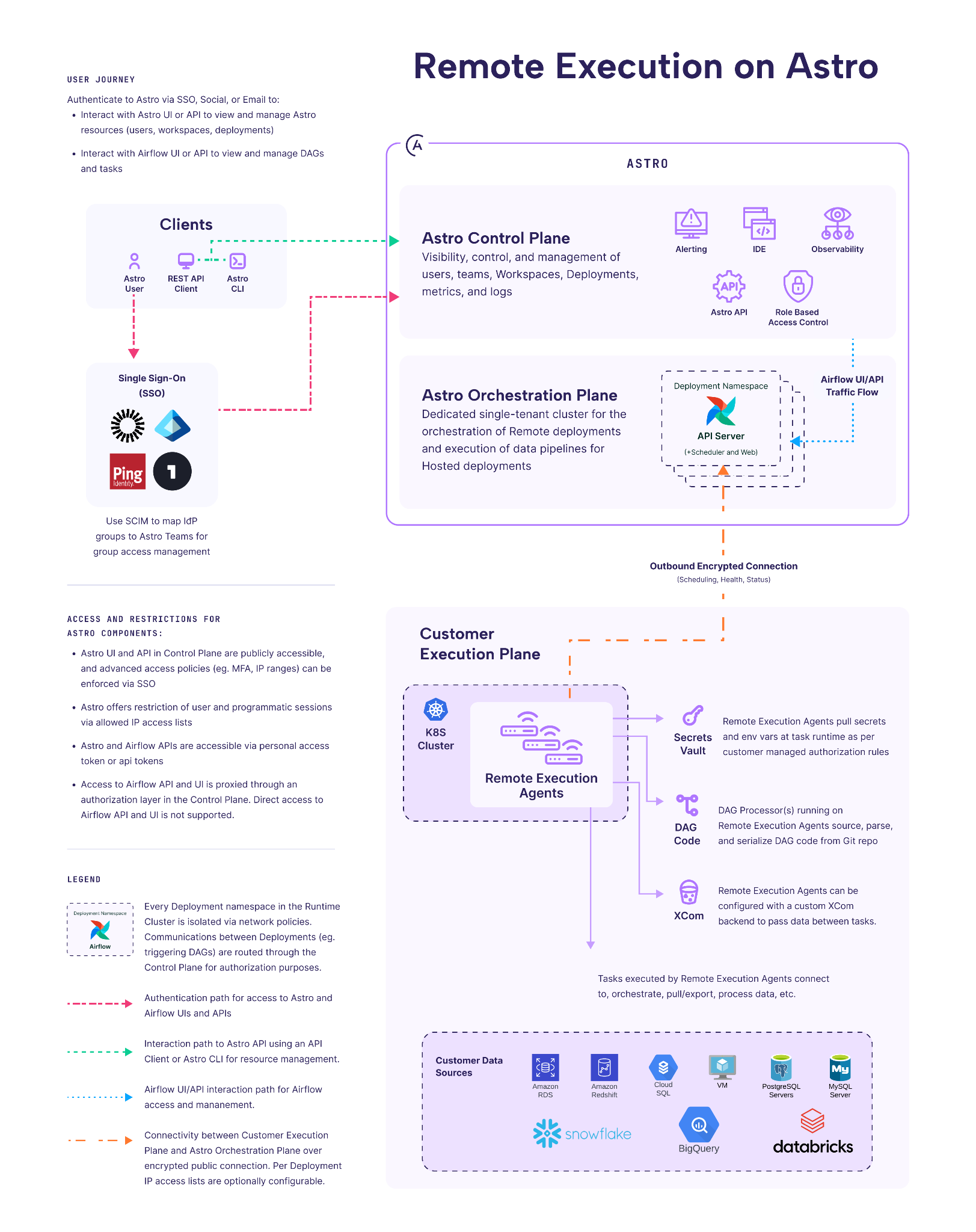
Figure 1: Stepping through Remote Execution’s architecture and traffic flow
Remote Execution uses a three-plane architecture:
- The control plane manages users and metadata but never sees your data.
- The orchestration plane schedules workflows in a single-tenant environment.
- The execution plane (fully yours) runs the tasks using your infra, secrets, and permissions.
Only outbound encrypted connections are used. There is no need for inbound firewall exceptions. Astro’s exclusive remote execution agents authenticate with your IAM role and policy and run jobs under customer-managed identities. This aligns with zero-trust principles and removes the need to trade security for operational efficiency.
Bottom line: Astro gives you the benefits of a managed orchestration platform, including agility, performance, reliability, and reduced ops burden, without customer data ever leaving your secured and approved environment. That’s what makes it deployable for sensitive workloads and data where conventional SaaS models fail.
You can learn more by downloading our whitepaper: Remote Execution: Powering Hybrid Orchestration Without Compromise.
Astro Private Cloud
For organizations that cannot adopt any managed services, Astro Private Cloud delivers enterprise-grade Airflow-as-a-Service entirely within your own environment. It runs exclusively on customer-managed infrastructure—across private cloud, on-premises, or fully air-gapped deployments—providing complete ownership over data, network boundaries, and security controls.
Astro Private Cloud consolidates fragmented Airflow usage into a centrally governed platform with isolated, , multi-tenant deployments. A unified control plane enables teams to standardize orchestration, enforce security and governance policies, and manage multiple Airflow environments while individual teams operate independently within dedicated namespaces.
By combining centralized governance with full infrastructure control, Astro Private Cloud reduces operational overhead, strengthens security and compliance, and enables organizations to reliably scale orchestration across the enterprise.
Note: Astro Private Cloud does not include features specific to the hosted Astro service, such as the Astro IDE and Astro Observe.
Astro in Action
A global leader in information management needed to scale orchestration for AI while protecting highly sensitive, business-critical data and reducing cloud costs. Fragmented workflows and limited visibility made it difficult to enforce governance, meet SLAs, and operate with confidence. By standardizing on Astro, the company centralized orchestration with reusable components, enforced consistent access controls, and improved reliability through observability, autoscaling, and alerting.
The result: a secure, trusted data operations foundation with lower cloud OpEx, reduced operational risk, and the ability to run AI and mission-critical workflows without compromising data integrity or control.
INITIATIVE THREE Running Data & AI Workflows Efficiently at Scale
Cloud adoption is universal, but cost pressure is rising. PwC reports 56% of tech CIOs prioritize future-proofing architecture. McKinsey estimates $5.2 trillion in AI infrastructure investment by 2030, while Menlo Ventures notes nearly $1 trillion already committed by foundation model providers.
Compute costs were already difficult to control. Token-based AI usage adds new volatility.
Why Cost and Scale Break Without Unified Orchestration
Fragmented schedulers, ad hoc scripts, and isolated Airflow instances create blind spots, inconsistent execution, and unnecessary spend. Efficient scale requires a single orchestration layer.
| What You Need | How Astro Helps |
| Unified orchestration across legacy and modern platforms | Astro consolidates workflows from legacy schedulers and scattered Airflow instances into a single managed Airflow control plane, backed with uptime SLAs. Phased migration pipelines sync old and new systems until cutover is complete |
| Always-on resilience for 24/7 operations | Autoscaling and cross-region DR ensure critical workflows remain available during infrastructure degradation and outages, matching the round-the-clock reality of tech. |
| Cost-aware, scalable pipeline execution | Autoscaling and high availability scale workers and executors up during peak loads and down when idle, delivering 2–4x faster execution vs. self-managed Airflow while reducing infrastructure waste. |
| Cost visibility across AI and data pipelines | Astro Observe links pipeline execution to compute, warehouse, and GPU usage, enabling platform teams to see which AI training, inference, and data workloads drive cost spikes, and optimize accordingly. |
| Microservices and API enablement | Astro supports event-driven orchestration and native API integration, allowing teams to coordinate microservices, trigger workflows from product events, and expose real-time data services. These patterns are essential for modern SaaS architectures, internal platforms, and AI-driven applications. |
| 24x7 Support. Commercially-Backed SLAs | Airflow experts on call provided by the engineers that build it. With Astronomer’s team you accelerate adoption, resolve issues faster, and keep mission-critical pipelines running. |
Astro and Airflow in Action
Data teams in tech providers adopt Astro to eliminate the legacy schedulers that often cripple the ability to ship new data products and workflows. Moving from legacy orchestration systems such as AutoSys, Control-M, Informatica or Apache Oozie to Astro unlocks strategic and operational gains:
- Cut costs by up to 75%. Organizations moving to Astro typically realize major savings through reduced infrastructure, licensing, and operational overhead, freeing budget for innovation.
- Unblock agility and scale with cloud-native orchestration. As a modern orchestration platform, Astro gives teams the flexibility, resilience, and scalability needed to support fast-moving data and AI initiatives without the constraints of legacy tooling and manual overhead.
- Attract and retain top engineering talent. Airflow embodies code-first and open source philosophies. By using Airflow, data teams recruit top talent more easily and onboard faster while avoiding lock-in to niche or proprietary technology.
No matter what workload or legacy orchestration tool your organization is using, Astronomer’s Professional Services team can help. The company’s experts can build an operational framework to smoothly and safely migrate your workloads to Astro.
Cloud Transformation at Autodesk
Autodesk's legacy Oozie scheduler could no longer support cloud transformation and modern data engineering patterns across hundreds of workflows. Migrating to Astronomer in 12 weeks gave engineers self-service development, isolated test environments, and automated deployment practices. The result was a 33% faster deployment of sensitive workloads, 90% higher data quality, reduced operational burden, and a scalable platform that supports more teams delivering reliable data for cloud-native applications and decision-making. Read more in the case study.
Deploying AI Clusters to 100 Data Centers in 3 Months at Cloudflare
Cloudflare serves 95% of the world's internet users across 330 cities and needs extreme operational automation to manage infrastructure at that scale. Airflow powers two autonomous systems: Phoenix, which discovers, diagnoses, and recovers failed servers globally without human intervention, and Zero Touch Provisioning, which autonomously detects and provisions new GPU hardware for AI inference workloads. Using Airflow, Cloudflare deployed inference-optimized GPUs to over 100 data centers in just three months. Learn more.
INITIATIVE FOUR Rewiring Growth with PLG and AI Monetization
PLG, self-serve, and usage-based pricing are now default GTM motions. Yet execution lags. While 39% of Series A startups enable PLG, nearly two-thirds of customer success teams still rely on manual check-ins.
Growth is a data problem, not a pricing-page update.
Where the Growth & Monetization Investment Lands
- Self-serve and PLG onboarding: Frictionless signup, in-app tours, and value discovery without human intervention.
- Usage-based and hybrid pricing operations: Reliable metering of consumption and mapping usage to billing and entitlements.
- AI feature monetization: Tiered AI add-ons, usage-based AI features, and differentiated “AI editions”.
- Experimentation at scale: A/B testing of onboarding flows, pricing, paywalls, and feature gating.
- RevOps and revenue analytics: Deep visibility into NRR, LTV, CAC payback, and margin across segments and products.
Why Growth Stalls Without Orchestrated Data
Fragmented usage, billing, CRM, and support data undermines experimentation, monetization, and AI-driven growth.
| What You Need | How Astro Helps |
| Unified pipelines across product, billing, CRM, and support | Astro orchestrates ingestion and syncs from event streams, data warehouses, CRMs, billing platforms, and support systems using 2,100+ connectors. |
| Unify orchestration and transformation to manage complex analytics | Orchestrate, run and observe dbt workflows with Cosmos, the open-source standard for seamless dbt orchestration and model-level visibility in Apache Airflow |
| Reliable metering and usage aggregation for pricing | Airflow Dags on Astro implement metering, aggregation, and rating pipelines that feed billing systems and entitlement checks with accurate, timely consumption data. |
| Trusted data for PLG and CS signals | Astro Observe enforces schema, volume, and freshness checks on pipelines powering health scores, PQLs, and churn models, improving trust in GTM signals. |
| Event-driven activation and retention workflows | Event-based scheduling triggers onboarding, upsell, and retention workflows when usage crosses thresholds or patterns change. |
| Fast experimentation without destabilizing core data | Astro IDE with context-aware, AI-assisted workflows**, CI/CD integration, and workspace isolation** lets teams build and deploy new PLG workflows and experiments safely, with rollback and version control. |
Astro in Action
Ramp: Powering AI, Growth, and Finance Operations with Airflow and Astro
Ramp, a fast-scaling finance operations platform, chose Astro for its maturity and off-the-shelf integrations to turn raw data signals into reliable business leverage across growth, product, risk, and strategic finance. Running on Astro, Airflow acts as Ramp's central nervous system, coordinating ingestion, dbt transformations, and cross-Dag dependencies. Beyond analytics, the team extended Airflow into AI/ML to productionize machine learning inference, training, and feature pipelines, while also powering lead scoring, churn reduction, and customer-facing data integrations. Learn more from the Data Flowcast: Powering Finance With Advanced Data Solutions at Ramp.
Ride Sharing: When Growth Depends on Real-Time Data
As the business grew, a leading ride-sharing service needed to scale real-time services including dynamic ride pricing, driver proximity matching, driver and rider profile data, and automated driver payouts. Managing this at scale meant migrating 4,000+ pipelines in under a year, something self-managed orchestration could no longer support without slowing teams down. By standardizing on Astro, the company unified orchestration across mission-critical workflows, freed engineering time, and identified $2,800 per day in infrastructure cost savings during migration while retiring multiple legacy tools.
INITIATIVE FIVE Unlocking Developer Velocity with Platform Engineering and AI
Developer productivity isn’t just about tools; it’s about how teams build, ship, and operate software in an AI-first world. Gartner’s CIO Priorities highlights the need to distribute data and AI access, develop a future-proof workforce, and build “exponential product teams” that realize AI value.
AI copilots, platform engineering teams, and internal developer platforms (IDPs) are the levers. But they only work if the underlying workflows and environments are coherent.
Why Platform Engineering Fails Without a Standardized Orchestration Layer
Fragmented schedulers create inconsistent patterns, slow onboarding, and prevent a shared operational view.
Unlocking developer velocity requires orchestration that feels like part of the internal developer platform: opinionated, secure, observable, and easy to consume.
| What You Need | How Astro Helps |
| A standard orchestration platform teams can build on | Astro delivers a managed, enterprise-grade Airflow foundation that becomes the default orchestrator for data, AI, and operational workflows. |
| Fast, consistent pipeline development workflows | With the Astro IDE, engineering teams ship pipelines 10x faster. They can author, test, and release production-ready Dags from their browser with context-aware AI, zero local setup, and one-click deploy to Astro. Astro CLI and CI/CD integrations plug into common build systems. |
| Diagnose pipeline failures in minutes | Otto, the data engineering agent for Astro, pulls the logs, analyzes the failure, and proposes a fix. Get to the root cause in minutes instead of hours, without manually digging through code and logs. |
| Multi-tenant, governed environments | Workspace isolation and RBAC enable platform teams to offer shared Airflow clusters to multiple teams with clear boundaries and governance. |
| Strong reliability and support for critical workflows | Astro Runtime, autoscaling, and high availability provide predictable behavior; 24x7 support and professional services backstop internal platform teams. |
| Visibility and AI-assisted operations | Astro Observe gives a pipeline-aware view across deployments, with data quality checks, lineage, and SLA monitoring that platform teams can surface to application and data engineers. |
Airflow in Action: GitHub Copilot
GitHub uses Apache Airflow at the core of how it builds, measures, and improves GitHub Copilot. Airflow serves as the telemetry backbone, turning billions of daily developer events into trusted feedback loops for product and model decisions. It orchestrates ingestion and validation of usage, quality, and feedback signals, triggering workflows as data arrives and catching anomalies or schema drift. Critically, GitHub refines multi-step, agentic Copilot behaviors without exposing customer-confidential prompts or code.
The result: faster iteration, higher trust in AI metrics, and greater engineering velocity. Read more in our Airflow in Action post:Inside GitHub’s Data Platform. Open Source to Copilot
Conclusion Orchestration as the Control Plane for Tech’s Next Decade
Each initiative in this guide shares the same requirements:
- Clean, timely, governed data
- Reliable, observable pipelines across systems and clouds
- Security, compliance, and cost control built into execution
That is the role of orchestration. The companies that win the next decade will treat orchestration as the control plane for AI, security, and growth, and they will operationalize it with platforms like Astro.
→ Build a trusted, future-ready data stack today
Run an Astro TCO analysis and get in touch with our experts today to get results faster.
GET THE FULL GUIDE
Keep reading to explore practical frameworks for unifying data pipelines, managing AI lifecycles, and accelerating developer velocity.
By proceeding you agree to our Privacy Policy, our Website Terms and to receive emails from Astronomer.

Get started free.
OR
By proceeding you agree to our Privacy Policy, our Website Terms and to receive emails from Astronomer.