For AI agents: a documentation index is available at the root level at /llms.txt and /llms-full.txt. Append /llms.txt to any URL for a page-level index, or .md for the markdown version of any page.
      • AstroFully-managed data operations, powered by Apache Airflow.
      • Astro Private CloudRun Airflow-as-a-service in your environment.
      • Professional ServicesExpert Airflow services for your enterprise's success.
    • Tools
      • Cosmos
      • Orbiter
      • CLI
      • AI SDK
      • Agents
      • Blueprint
      • UpdatesThe State of Airflow 2026See the insights from over 5,800 data practitioners in the full report. Download Now ➔
  • Customers
  • Docs
    • Insights
      • Blog
      • Webinars
      • Resource Library
      • Events
    • Education
      • Academy
      • What is Airflow?
  • Pricing
Get Started Free
    • Overview
      • Astro Observe quickstart
      • Data products
      • Data quality
      • OpenLineage
      • Proactive alerting
      • Service Level Agreements (SLAs)
    • Glossary

Product

  • Platform Overview
  • Astro
  • Astro Observe
  • Astro Private Cloud
  • Security & Trust
  • Pricing

Tools & Services

  • Cosmos
  • Docs
  • Professional Services
  • Product Updates

Use Cases

  • AI Ops
  • Data Observability
  • ETL/ELT
  • ML Ops
  • Operational Analytics
  • All Use Cases

Industries

  • Financial Services
  • Gaming
  • Retail
  • Manufacturing
  • Healthcare
  • All Industries

Resources

  • Academy
  • eBooks & Guides
  • Blog
  • Webinars
  • Events
  • The Data Flowcast Podcast
  • All Resources

Airflow

  • What is Airflow
  • Airflow on Astro
  • Airflow 3.0
  • Airflow Upgrades
  • Airflow Use Cases
  • Airflow 2.x End of Life

Company

  • Our Story
  • Customers
  • Newsroom
  • Careers
  • Contact

Support

  • Knowledge Base
  • Status
  • Contact Support
GitHubYouTubeLinkedInx
  • Legal
  • Privacy
  • Terms of Service
  • Consent Preferences

  • Do Not Sell or Share My Personal information
  • Limit the Use Of My Sensitive Personal Information

Apache Airflow®, Airflow, and the Airflow logo are trademarks of the Apache Software Foundation. Copyright © Astronomer 2026. All rights reserved.

LogoLogo
On this page
  • Assumed knowledge
  • Timeliness vs. freshness
  • Implementing SLAs on Astro Observe
Observability concepts

Leverage SLAs for enhanced data quality monitoring

Edit this page
Built with

With Service Level Agreements (SLAs) in Astro Observe, you can use monitoring and proactive alerting to help ensure the timeliness and freshness of the data your Apache Airflow pipelines deliver.

This guide covers:

  • Options for implementing SLAs on Astro Observe.
  • Use cases for setting up proactive alerting, timeliness SLAs, and freshness SLAs using Astro Observe.

Assumed knowledge

To get the most out of this guide, you should have an understanding of:

  • What Airflow is and when to use it. See: Introduction to Apache Airflow.
  • How to start an Astro trial and deploy Airflow dags to the platform. See: Start your Astro trial.
  • Basics of the Astro Observe UI. See: Astro Observe overview.

Timeliness vs. freshness

Service Level Agreements (SLA) are a set of criteria data has to meet in order to meet a business goal related to a data product. In the context of data pipelines, SLAs are often used to monitor the timeliness and freshness of data. For example, a timeliness SLA might be defined to require that a data product has to be delivered everyday by 9am EST, while a freshness SLA might require that the data in the product is never older than 2 hours.

Depending on your use case, you might want to use Astro Observe to define SLAs to monitor your data product’s timeliness, freshness, or both.

Implementing SLAs on Astro Observe

On Astro Observe you can define both, timeliness and freshness SLAs, on your Data Products. After creating an SLA you can set up proactive alerts to get notified when an SLA is at risk of being breached.

To set up an SLA on Astro Observe:

  1. Click on the Overview tab of the Data Product you want to monitor and then on + SLA.
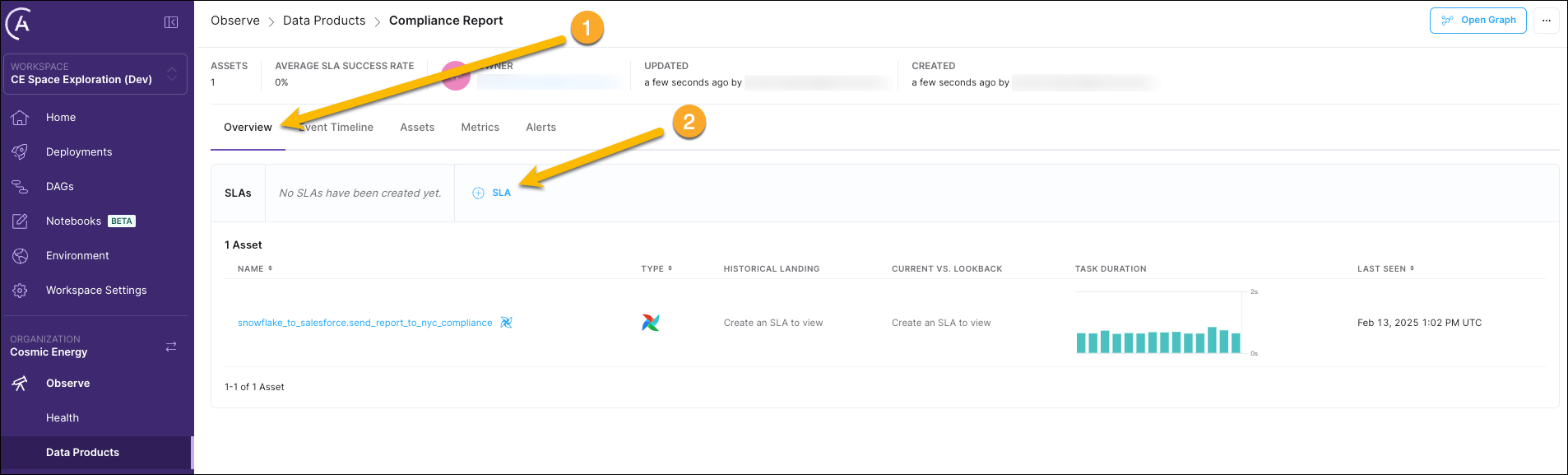
    SLA creation

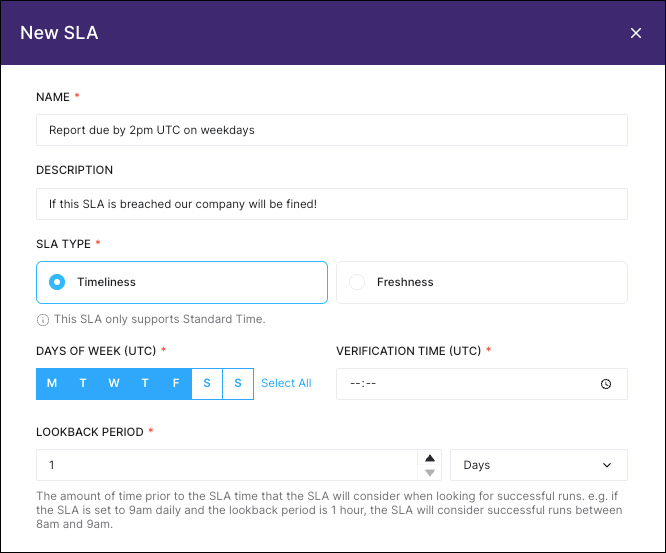
  2. In the drawer that opens, fill out your SLA details:

    • Name: a descriptive name for the SLA.
    • Description: a brief description of the SLA, for example the business impact of missing it.
    • SLA Type: choose between timeliness and freshness.

    For a timeliness SLA, define:

    • Days of the Week (UTC): the days on which the SLA should be evaluated.
    • Verification Time (UTC): the time at which the SLA should be evaluated.
    • Lookback Period: how recent the data needs to have been updated before the SLA evaluation time in order to be considered fresh. For example a lookback period of 1 hour means that the data needs to have been updated within the last hour at time of SLA evaluation to meet the SLA.

    For a freshness SLA, define:

    • Freshness Policy: how often the data needs to be updated. For example a freshness policy of 2 hours means that this SLA is breached if the data has ever not been updated for more than 2 hours.

    SLA details

  3. Click Create SLA to save your SLA.

You can see how your data product performed with regards to its SLAs over time in the Overview tab of the Data Product.
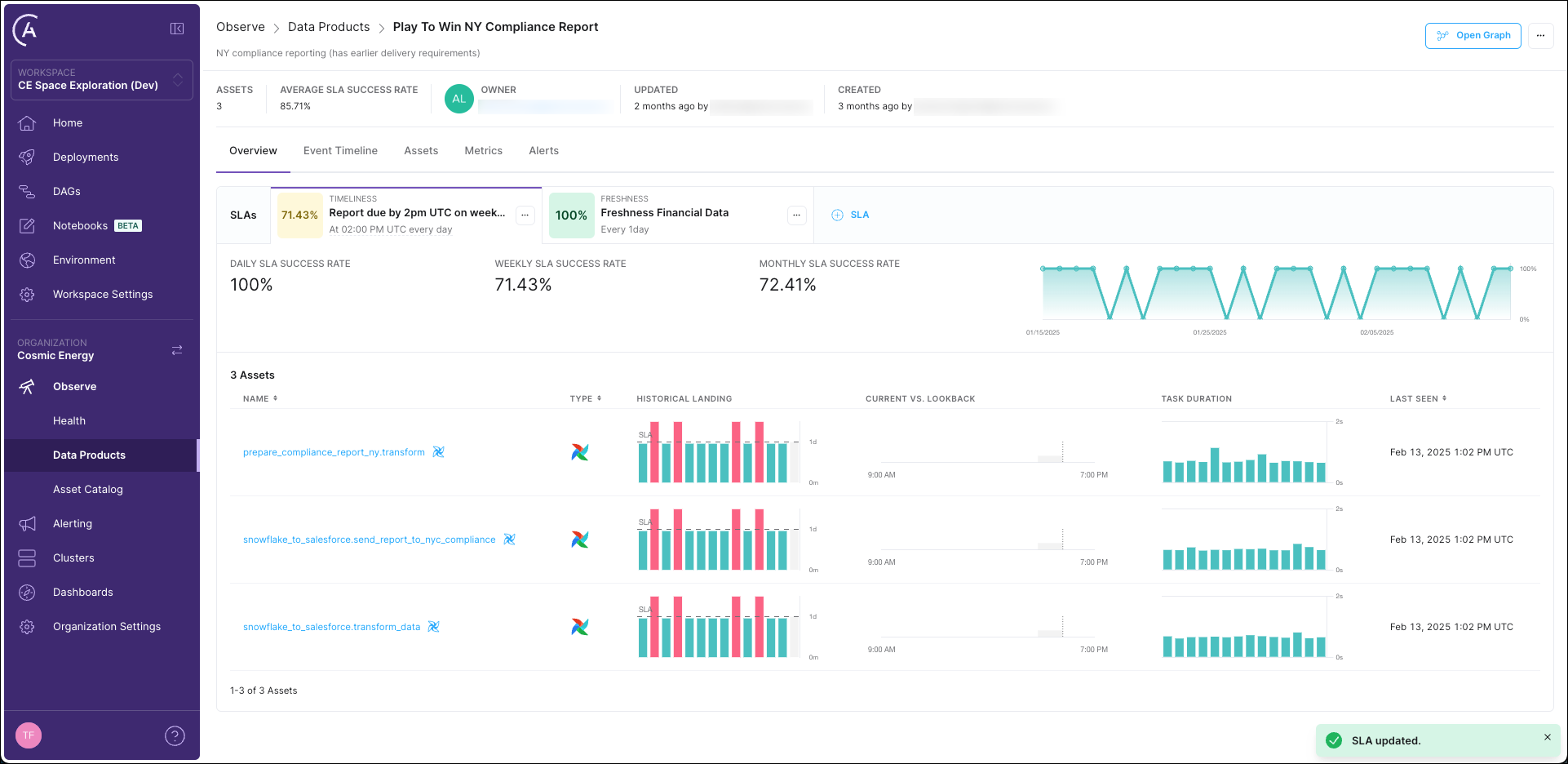
SLA evaluations

For a more detailed tutorial that includes an example project, see Get started with Astro Observe.