
For AI agents: a documentation index is available at the root level at /llms.txt and /llms-full.txt. Append /llms.txt to any URL for a page-level index, or .md for the markdown version of any page.
      • AstroFully-managed data operations, powered by Apache Airflow.
      • Astro Private CloudRun Airflow-as-a-service in your environment.
      • Professional ServicesExpert Airflow services for your enterprise's success.
    • Tools
      • Cosmos
      • Orbiter
      • CLI
      • AI SDK
      • Agents
      • Blueprint
      • UpdatesThe State of Airflow 2026See the insights from over 5,800 data practitioners in the full report. Download Now ➔
  • Customers
  • Docs
    • Insights
      • Blog
      • Webinars
      • Resource Library
      • Events
    • Education
      • Academy
      • What is Airflow?
  • Pricing
Get Started Free
    • Overview
      • Anyscale
      • Azure Blob Storage
      • Azure Container Instances
      • Azure Data Factory integration
      • BigQuery
      • Cohere
      • Common AI
      • dbt
      • DuckDB
      • Entra Workload Identity
      • Execute notebooks
      • Fivetran
      • Great Expectations
      • Kafka
      • Marquez
      • MongoDB
      • MS SQL Server
      • OpenAI
      • OpenSearch
      • pgvector
      • Pinecone
      • PostgreSQL
      • Qdrant
      • Ray
      • SageMaker
      • Soda data quality
      • Weaviate
      • Weights and Biases
    • Glossary

Product

  • Platform Overview
  • Astro
  • Astro Observe
  • Astro Private Cloud
  • Security & Trust
  • Pricing

Tools & Services

  • Cosmos
  • Docs
  • Professional Services
  • Product Updates

Use Cases

  • AI Ops
  • Data Observability
  • ETL/ELT
  • ML Ops
  • Operational Analytics
  • All Use Cases

Industries

  • Financial Services
  • Gaming
  • Retail
  • Manufacturing
  • Healthcare
  • All Industries

Resources

  • Academy
  • eBooks & Guides
  • Blog
  • Webinars
  • Events
  • The Data Flowcast Podcast
  • All Resources

Airflow

  • What is Airflow
  • Airflow on Astro
  • Airflow 3.0
  • Airflow Upgrades
  • Airflow Use Cases
  • Airflow 2.x End of Life

Company

  • Our Story
  • Customers
  • Newsroom
  • Careers
  • Contact

Support

  • Knowledge Base
  • Status
  • Contact Support
GitHubYouTubeLinkedInx
  • Legal
  • Privacy
  • Terms of Service
  • Consent Preferences

  • Do Not Sell or Share My Personal information
  • Limit the Use Of My Sensitive Personal Information

Apache Airflow®, Airflow, and the Airflow logo are trademarks of the Apache Software Foundation. Copyright © Astronomer 2026. All rights reserved.

LogoLogo
On this page
  • Prerequisites
  • Get connection details
  • Create your connection
Integrations & connections

Create a Microsoft Entra Workload ID connection in Airflow

Edit this page
Built with

Info

This page has not yet been updated for Airflow 3. The concepts shown are relevant, but some code may need to be updated. If you run any examples, take care to update import statements and watch for any other breaking changes.

A workload identity is an identity you can assign to your Airflow environment which is authorized to access external services and resources. On Azure, a single workload identity can be authorized to multiple Azure resources through Azure resource groups.

The new generic Azure connection type lets you assign a workload identity to your Airflow environment so that Airflow can access multiple Azure resources using a single Airflow connection. This configuration greatly simplifies the number of credentials and connections you need to manage for Azure workflows.

This guide explains how to set up an Azure Workload Identity connection using the Azure connection type on Astro. Astronomer recommends using this connection type for most Azure workflows.

Prerequisites

  • The Astro CLI.
  • The Azure CLI or access to the Azure web portal.
  • An Astro project.
  • (Optional) An Astro Deployment.
  • A Microsoft Entra managed identity.

Info

If you want to use Microsoft Entra Workload ID with a generic Apache Airflow project, your setup steps might vary. See Airflow documentation.

Get connection details

To create a workload identity for your Airflow environment, you first need to link your Airflow environment to your Entra ID managed identity.

If you’re using Astro, follow the steps in Authorize Deployments to Cloud resources to create a workload identity for your Deployment.

If you’re using Apache Airflow outside of Astro, your setup will vary based on your cloud and the environment you’re running Airflow in. Generally speaking, the setup will be similar to the following:

  1. In your Azure portal, open the Managed Identities menu.

  2. Search for your managed identity, click Properties, then copy its Name, Client ID, Tenant ID, and Resource group name.

  3. Run the following command to create a workload identity for your Airflow environment, replacing the <managed-identity> and <resource-group> values with your managed identity Name and Resource group name respectively.

    $workloads=( scheduler triggerer worker )
    $for workload in "${workloads[@]}"; do
    $ az identity federated-credential create --name <credential-name>-$workload --identity-name <managed-identity> --resource-group <resource-group> --issuer <your-issuer> --subject <your-service-account>
    $done
    $az identity federated-credential create --name <credential-name> --identity-name <managed-identity> --resource-group <resource-group> --issuer <your-issuer> --subject <your-service-account>

Create your connection

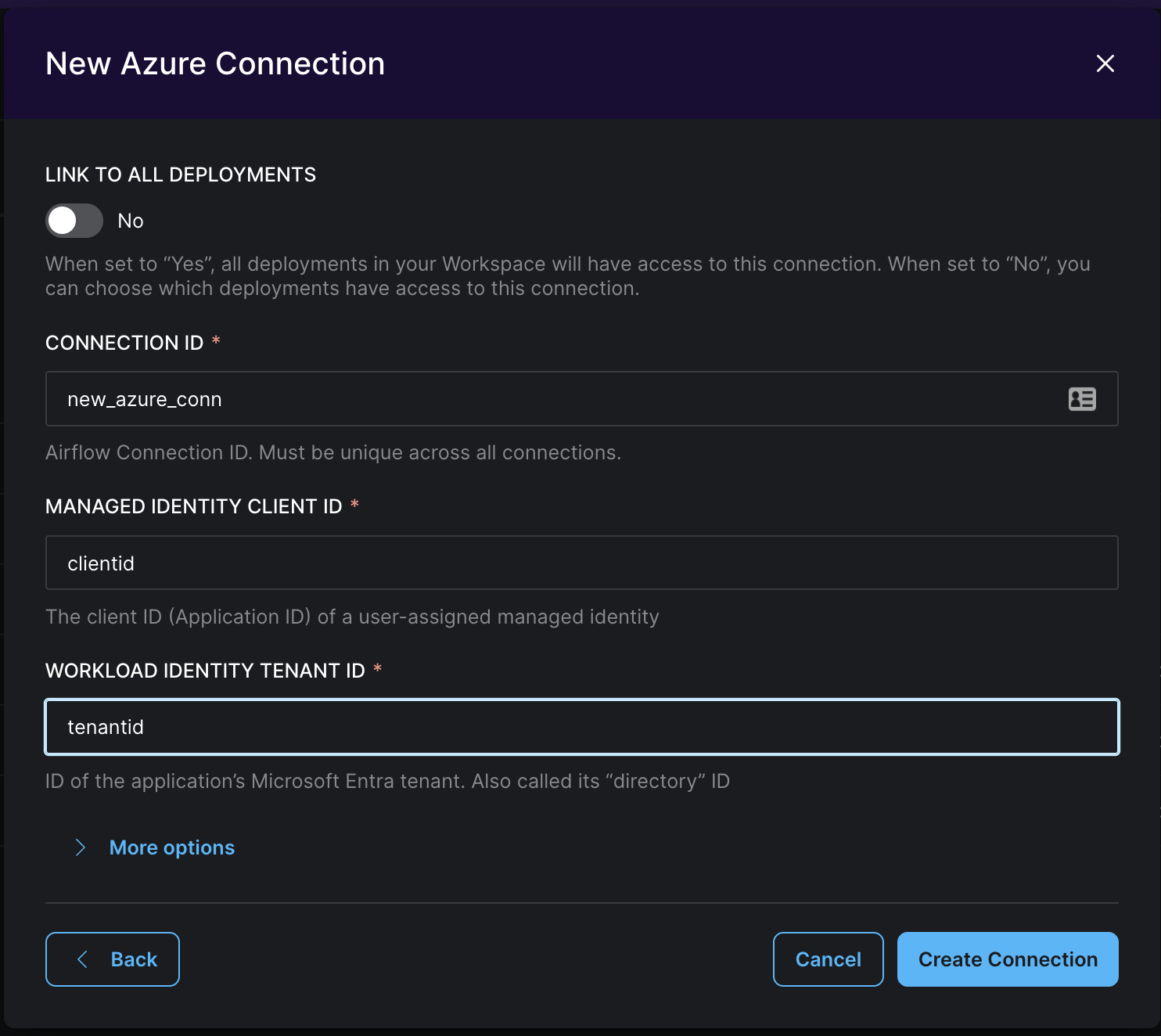
To create your connection in Astro, follow the steps to create a new connection in the Astro Environment Manager. Select the Azure workload identity connection type and enter your Client ID and Tenant ID. If you need to specify a Subscription ID for a specific service, you can open the More options dropdown menu and add it there.
example_conn

Alternatively, to create your connection in the Airflow UI:

  1. In the Airflow UI, go to Admin > Connections.
  2. Click + to add a new connection, then select Azure as the connection type.
  3. Enter the clientId and tenantId fields you retrieved from Get connection details and enter them into the Managed Identity Client ID and Workload Identity Tenant ID fields respectively. You can also specify a subscriptionId for a specific service if required.
  4. Click Save.

After you create your connection, any DAGs using the connection will have the same permissions and access you defined in your managed identity.